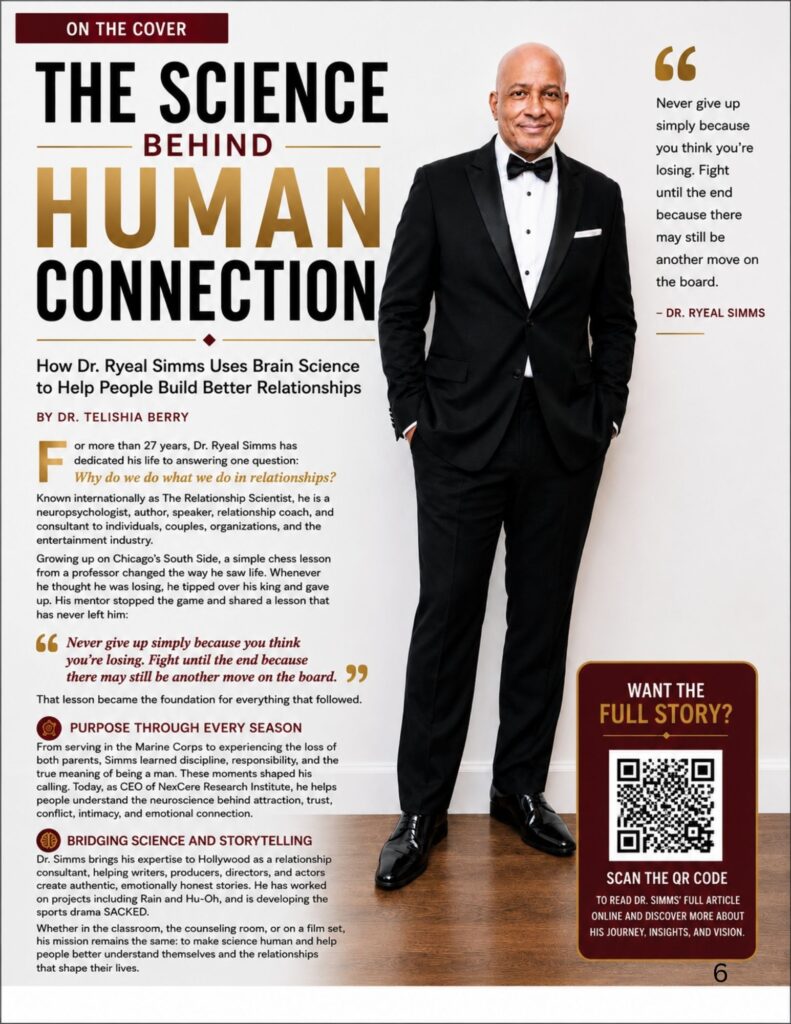
How Dr. Ryeal Simms Uses Brain Science to Help People Build Better Relationships
Â
For more than 27 years, Dr. Ryeal Simms has devoted his career to answering one fascinating question:
Why do people think, feel, and behave the way they do?
Known internationally as The Relationship Scientist, Simms has built his life’s work around understanding the brain and translating complex science into something people can actually use in their everyday lives.
As a neuropsychologist, relationship scientist, author, educator, and CEO of NexCere Research Institute, he explores how the brain influences communication, attraction, trust, intimacy, conflict, body language, decision-making, and emotional connection.
His work has taken him from classrooms and research settings to relationships, organizations, stages, and the entertainment industry.
Yet beneath the credentials and science is a much simpler mission.
He wants people to understand themselves better.
And in many ways, that mission began long before Dr. Simms ever studied the human brain.
THE LESSON THAT CHANGED EVERYTHING
Growing up on Chicago’s South Side, Simms learned an important lesson from an unlikely place: a chessboard.
As a young man learning to play, whenever he believed he was losing, he would tip over his king and surrender.
In his mind, the outcome was obvious. The game was over.
But one day, his professor stopped him.
Instead of accepting the surrender, he challenged Simms to keep playing and gave him advice that would stay with him for decades.
“Never give up simply because you think you’re losing. Fight until the end because there may still be another move on the board.”
It was a lesson about chess, but Simms eventually realized it was also a lesson about life.
Things are not always as they appear.
A difficult moment does not necessarily mean defeat.
And sometimes, when you believe you’ve exhausted every possibility, there is still another move available.
That philosophy would follow him through military service, personal challenges, loss, education, relationships, and the development of a career centered on understanding human behavior.
The chessboard taught him perseverance.
Science would eventually help him understand why people need it.
UNDERSTANDING THE BRAIN BEHIND THE BEHAVIOR
One of the things that makes Simms’ work distinctive is his ability to connect scientific concepts to ordinary human experiences.
Why do two people hear the same words but interpret them completely differently?
Why do some people shut down during conflict while others become more confrontational?
Why are we attracted to certain people?
Why do past experiences continue influencing present relationships?
Why can someone know logically that a behavior is unhealthy and still repeat it?
For Simms, those questions are not simply about personality.
The brain matters.
Our experiences, emotions, learned behaviors, stress responses, perceptions, and patterns of connection all influence the way we interact with the people around us.
Understanding those processes can give people language for experiences they may have struggled for years to explain.
That’s where Simms believes science becomes especially powerful.
It can move beyond theories and terminology and become a tool for better communication, greater self-awareness, and healthier relationships.
WHERE SCIENCE MEETS RELATIONSHIPS
Relationships are among the most important and complicated experiences of human life.
We want to feel understood.
We want to feel valued.
We want to connect.
Yet two people can love each other and still struggle to communicate.
Simms’ work examines what may be happening beneath those interactions.
He teaches people to look beyond the surface of an argument or misunderstanding and consider the emotional and neurological processes influencing how they respond.
That doesn’t remove personal responsibility.
Instead, understanding behavior can help people become more intentional about it.
When people understand their patterns, triggers, communication styles, and emotional responses, they have a greater opportunity to make different choices.
For Simms, that is one of the most important benefits of making brain science accessible.
Knowledge becomes useful when people can apply it to their lives.
WHERE SCIENCE MEETS STORY
His understanding of human behavior has also created an interesting bridge between science and entertainment.
Simms has worked with writers, directors, producers, and actors to help bring greater psychological and emotional authenticity to characters and stories.
It’s a natural connection.
Great storytelling depends on believable human behavior.
Audiences may not understand the neuroscience behind a character’s response to fear, attraction, rejection, grief, trauma, or intimacy, but they recognize when an emotion feels real.
For actors, understanding what may be happening internally can add another layer to a performance. For writers and directors, understanding human behavior can help create characters whose choices feel emotionally grounded rather than simply convenient to the plot.
In that sense, Simms isn’t just studying relationships.
He’s studying the very behaviors storytellers have been trying to capture for generations.
MAKING SCIENCE HUMAN
Despite his impressive credentials, Dr. Simms believes his greatest responsibility is making science accessible.
“I want people to understand themselves better.”
Whether teaching neuroscience, relationship dynamics, intimacy, body language, communication, or emotional healing, his mission is to give people language for experiences they often struggle to explain.
And perhaps that is what makes his work especially relevant today.
We live in a world where people are more connected technologically than ever before, yet meaningful human connection can still be difficult.
We text.
We post.
We scroll.
We communicate constantly.
But communication and connection are not necessarily the same thing.
Understanding how people think, feel, respond, and relate may help us become better partners, parents, friends, colleagues, leaders, and storytellers.
For Simms, knowledge isn’t valuable simply because we possess it.
Its greatest value may be what we do with it.
When asked what defines a courageous man, his answer reflects many of the principles that have shaped his own journey.
“A Courageous Man keeps showing up with integrity when life gives him reasons to quit. He takes responsibility for his choices, protects what matters, serves beyond himself, and uses his knowledge and experience to help others grow.”
Then he returns to the lesson that has guided him for decades.
“There may still be another move on the board.”
For Dr. Ryeal Simms, that isn’t simply a lesson about chess.
It’s a philosophy for life.
Â
Connect with Dr. Ryeal Simms